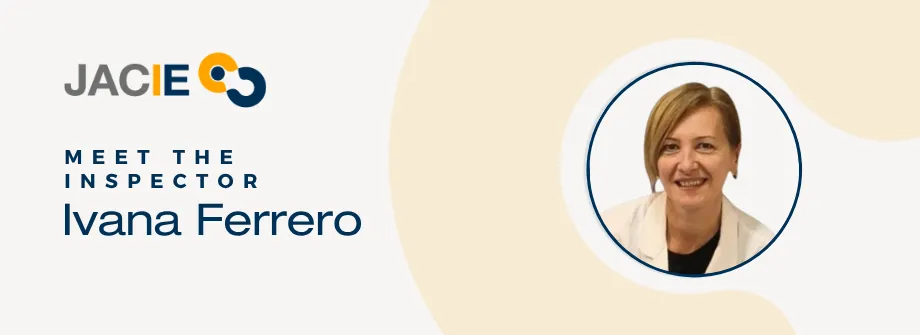
Inspectors are the backbone of JACIE; without them, there is no certification process. Becoming an inspector is a wonderful way to contribute to maintaining global quality standards. As the number of JACIE applications has increased, we are constantly looking for new inspectors to join our ranks. At the moment, we are particularly keen to hear of German, French and Spanish speaking Clinicians and Quality Managers.
Each month, you will have the opportunity to meet with one of our JACIE Inspector who will share his/her experience.
Read our interview with Ivana Ferrero.
Introduce yourself and your role(s) and position(s) within EBMT and outside of EBMT
My name is Ivana Ferrero. I have been a JACIE inspector since 2004, initially for Processing and, since 2016, also for Quality Management. From 2010 to 2020, I was also a Report Assessor.
I work at the Stem Cell Transplantation Laboratory of Regina Margherita Children’s Hospital in Turin, Italy, where I am Head of the Processing Facility.
Why did you decide to become a JACIE inspector?
It was a long time ago! In January 2004, I attended one of the first JACIE accreditation training courses in Barcelona. At that time, our centre was applying to JACIE accreditation, so it was a great opportunity to learn more about JACIE and quality management. A few months later, in May, I attended the inspector training course and decided to become an inspector.
What has been the most memorable inspection that you have ever done?
I would say that every inspection left its mark in some way. However, I particularly remember my very first inspection, in Bellinzona, Switzerland, in September 2004. Riccardo Saccardi was the Team Leader, and it was a great honour and a valuable learning experience to work with him.
All the inspections I have done outside Italy have also been challenging, not only for the language, but very interesting because they gave me the opportunity to experience different approaches to the transplant care and share different ways of working. Among these, there was the inspection in Porto, where I had previously spent time during my Erasmus experience. It was a wonderful opportunity to refresh my Portuguese and, in a way, to take a journey back in time!
What ‘keys to successful JACIE certification’ can you share with us?
Read the Standards and, above all, the Manual. It contains many useful suggestions and can help to clarify doubts and find solutions to practical problems.
And I would also suggest removing the sentence “We have always done it this way” from your vocabulary! Accreditation is an opportunity to look at what you do, improve established practices and to be open to change and innovation.
How has your career/work benefited from being a JACIE inspector?
Being a JACIE inspector has given me the opportunity to meet many colleagues from different countries and to deal with common problems and challenges. I have learned from other centres and from other inspectors, sometimes practical tricks, sometimes completely different approaches to the same problem. We have shared challenges, exchanged ideas and, moreover, encouraged and supported each other.
Being an inspector has definitely been a continuous learning experience, both professionally and personally.
Do you have any tips or advice for anyone who aspires to become a JACIE Inspector?
There is one sentence that I have repeated for many years, both during inspections and in the training sessions where I have had the opportunity to give short presentations: Do not follow the checklist line by line. The Standards are a guide, but it is important to understand the processes and the connections between them rather than simply going through each item one after another.
As a Team Leader, I would add another important advice: keep an eye on the timetable! There are many things to see during an inspection, and curiosity can easily make you spend too much time on particular topics. Divide the tasks within the team, communicate with each inspector and make good use of everyone's expertise. There is a lot to learn during an inspection, but time goes quickly!