
Building on the latest EBMT–EHA gene therapy guidelines, this two-part webinar series (April & June) supports knowledge sharing, clinical decision-making, and the evolution of care standards for patients with TDT and SCD.
What They Are and How They Work
The treatment landscape of haemoglobinopathies is undergoing a profound transformation. Forty years ago, allogeneic Haematopoietic Stem Cell Transplantation marked the beginning of a new era by offering the first curative option for Transfusion-Dependent Thalassemia (TDT) and Sickle Cell Disease (SCD). Since then, more than 10,000 patients worldwide have benefited from transplantation. Today, with gene therapy entering clinical practice, patients and physicians are facing an unprecedented expansion of therapeutic choices.
In this rapidly evolving landscape, these webinars will provide clinicians with clear, practical guidance on the management of haemoglobinopathies. International experts will present the latest evidence on conventional treatments, transplantation strategies, and emerging options such as gene therapy, offering concrete answers to key clinical questions on indications, expected outcomes, and long-term follow-up to support evidence-based treatment decisions for patients with TDT and SCD.
EBMT is uniquely positioned to lead this dialogue, especially following the recent development of joint EBMT–EHA guidelines on gene therapy in haemoglobinopathies (SCD guidelines published in 2025 in HemaSphere, and TDT guidelines currently under revision in Bone Marrow Transplantation). Through these webinars, the HWP aims to support knowledge dissemination, stimulate discussion, and contribute to shaping the future standards of care for patients with TDT and SCD.
- Update on State-of-the-Art Management – Provide expert physicians with the latest evidence on conventional treatments and transplantation strategies for TDT and SCD, reflecting current standards and emerging consensus.
- Evaluate Innovative Therapies – Explore novel therapeutic approaches, including gene therapy, with a focus on indications, expected outcomes, long-term follow-up, and integration into clinical practice.
- Enhance Evidence-Based Decision-Making – Support expert clinicians in translating up-to-date knowledge into patient-centered treatment strategies, optimizing outcomes across diverse haemoglobinopathy populations.
Upcoming Webinar
The Heamoglopinopathies Working Party Webinars will return in the next year
Our webinar series has officially concluded for the year after two successful sessions. We will return in the next year, bringing new insights and relevant discussions on the industry's most pressing topics.
Thank you to everyone who joined us this year.
Past Webinars
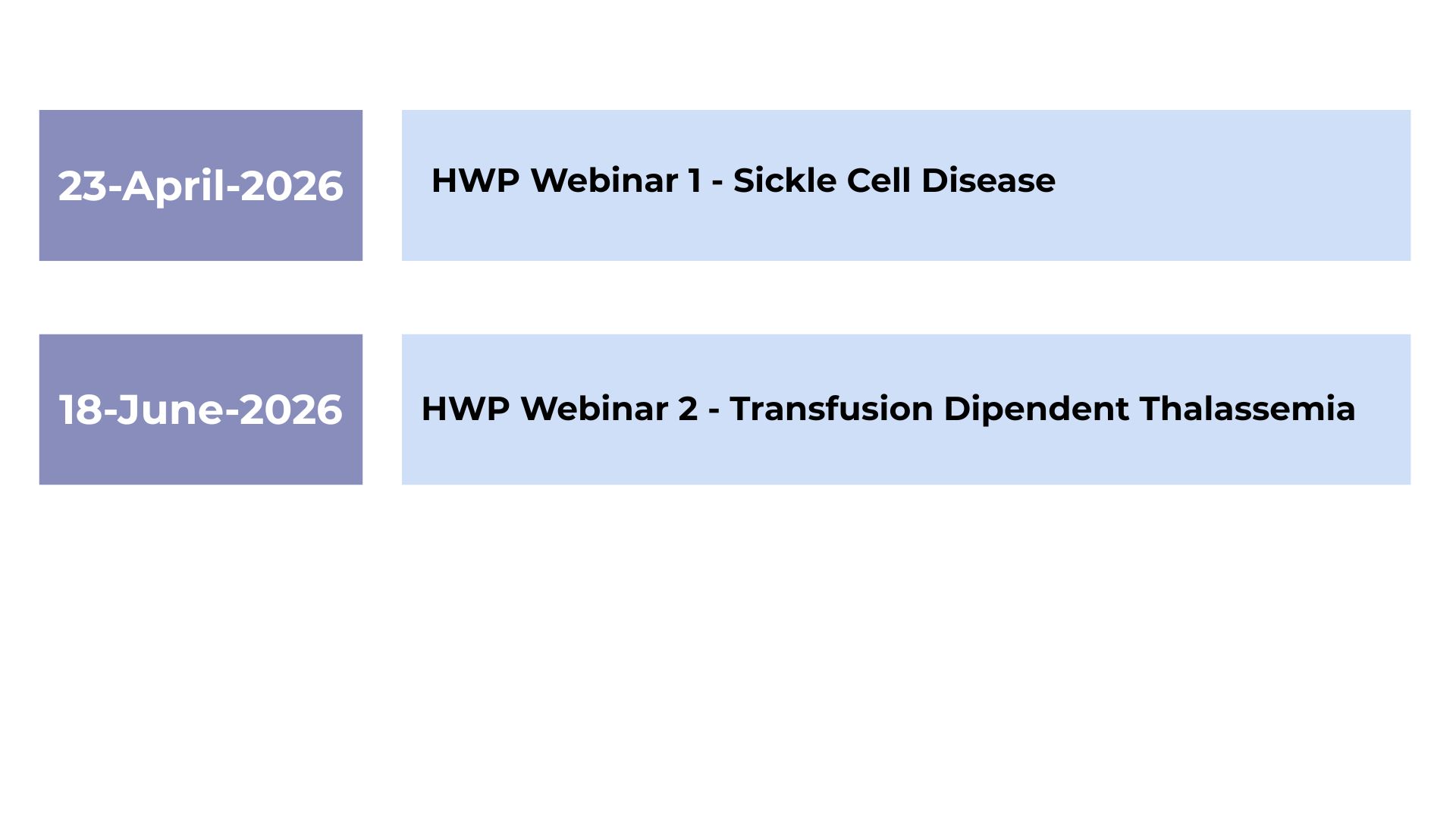
Transfusion Dependent Thalassaemia
Date: 18th of June, 2026.
Time: 16:00 CET
Description:
This second webinar focuses on Transfusion Dependent Thalassemia (TDT) providing a practical and up-to-date overview of the disease and its expanding treatment landscape.
Transfusion-dependent thalassemia (TDT) is an inherited disorder in which patients require chronic transfusion and iron chelation therapy. Allogeneic hematopoietic cell transplantation is currently the only widely available curative option worldwide; however, this procedure requires an HLA-identical donor, which is not available for the majority of patients. In addition, age is another factor that impacts the outcome of the procedure, with better results observed in younger patients.
With the advent of gene therapy procedures and the promising results of gene therapy trials, a new and potentially curative treatment is now available for patients with these hemoglobinopathies.
However, there are still questions and concerns regarding indications, outcomes, and follow-up.
This webinar aims to provide information on the current state of the art in the treatment of this disease, focusing on key questions and reporting experiences and clinical results from the real world, including low-income settings.
Panel of experts:
Moderator
Donatella Baronciani
Speakers
Valeria Pinto
Roland Meisel
Miguel Abboud
Learning Objectives
This episode will:
- Summarise current management of TDT, including recent advances in medical treatment.
- Evaluate the role of HSCT and gene therapy, including indications and clinical outcomes.
- Compare treatment options across different resource settings, particularly in low-income countries.
Webinar recording coming soon!
Sickle Cell Disease
Description:
This first webinar focuses on Sickle Cell Disease (SCD), providing a practical and up-to-date overview of the disease and its expanding treatment landscape.
International experts will review disease mechanisms and clinical presentation, alongside new medical therapies that are reshaping standard care. The session will also explore curative approaches, including haematopoietic stem cell transplantation (HSCT) and gene therapy (GT), with a focus on their indications and expected outcomes in 2026.
Finally, the webinar will address treatment strategies and outcomes in low-income countries, highlighting global disparities in access to care and their impact on clinical decision-making.
Panel of Experts:
Moderator
Donatella Baronciani
Speakers
Lucia De Franceschi
Ruah Alyamany
Fabio Giglio
Learning objectives:
This episode will:
- Summarise current management of TDT and SCD, including recent advances in medical treatment.
- Evaluate the role of HSCT and gene therapy, including indications and clinical outcomes.
Compare treatment options across different resource settings, particularly in low-income countries.