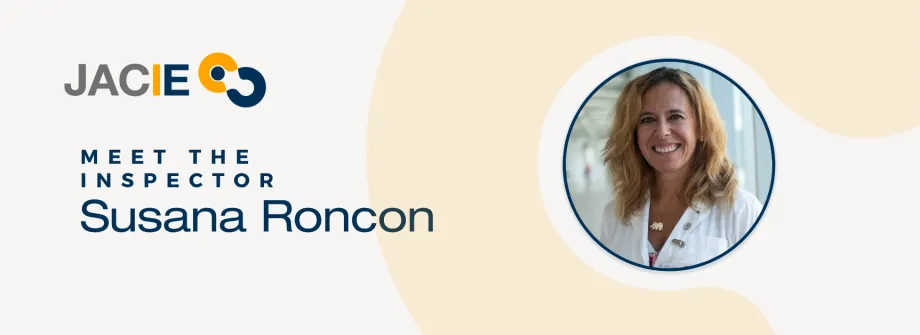
Inspectors are the backbone of JACIE; without them, there is no certification process. Becoming an inspector is a wonderful way to contribute to maintaining global quality standards. As the number of JACIE applications has increased, we are constantly looking for new inspectors to join our ranks. At the moment, we are particularly keen to hear of German, French and Spanish speaking Clinicians and Quality Managers.
Each month, you will have the opportunity to meet with one of our JACIE Inspector who will share his/her experience.
Read our interview with Susana Roncon.
Introduce yourself and your role(s) and position(s) within EBMT and outside of EBMT
I am a medical doctor with a long-standing involvement in hematopoietic cell transplantation, cellular therapies, and bone marrow donation. I work in an oncology hospital, that has been affiliated with the EBMT for nearly 20 years, where my role combines clinical activity with the operational and regulatory aspects of transplant programmes, particularly in areas related to patient safety, multidisciplinary collaboration, and quality management. Since 2019, I have also been actively involved in the IEC programme at my institution, contributing to the care of patients with hematological malignancies across the northern region of Portugal.
Within the JACIE community, I have had the privilege of serving as a JACIE inspector since completing the inspector training course in 2014 under the guidance of Eoin McGrath, to whom I remain deeply grateful for believing in me and encouraging me to pursue this role.
Why did you decide to become a JACIE inspector?
My decision came from a genuine curiosity about how high-performing transplant centres build and sustain excellence in everyday practice. And, quite honestly, from the desire to bring those same standards and ideas back to my own institution.
In some programmes, I was impressed by how naturally the JACIE culture was embedded into daily clinical and organisational routines. In others, I observed the remarkable recognition of JACIE as a true professional and regulatory benchmark. What consistently stood out across all the centres I visited was the combination of innovation, critical thinking, and collective responsibility behind transplantation programmes.
Over the years, inspections have given me the opportunity to work alongside outstanding colleagues and centres across Europe and Asia. More importantly, they have shown me that JACIE is much more than a certification framework. It creates a common professional language across very different healthcare systems while continuously challenging us to improve the way we care for patients.
What has been the most memorable inspection that you have ever done?
The inspections that left the deepest impression on me were those in which professionalism and teamwork become evident. Some of them were shared with colleagues, such as John Fitzgerald and Olivier Urbain, who consistently enriched the entire process. Working alongside people with such strong technical expertise and balanced judgement reminded me that JACIE’s culture is truly a peer-to-peer evaluation built on mutual respect.
One inspection that particularly stayed with me involved a programme working under pressure and with limited resources, yet functioning with remarkable efficiency and humanity. There was a clear collective mindset throughout the team, with everyone sharing the same objective. What impressed me most was not a specific procedure or document, but the way in which quality and care for patients were naturally woven into their daily practice.
What ‘keys to successful JACIE certification’ can you share with us?
The centres that succeed most consistently with JACIE are those that understand that certification is not a prize, but the natural consequence of a mature organisational culture. Successful programmes integrate quality management into routine clinical and laboratory practice: standard operating procedures are easy to follow, deviations are analysed honestly, audits are taken seriously, and communication between teams is open and constructive.
From the inspector’s perspective, we are not searching for perfection. We are looking for consistency, transparency, and evidence that the programme can recognise and correct its own vulnerabilities. Programmes that demonstrate self-awareness and a genuine willingness to improve are often the strongest ones.
I should also highlight the continuous support of the JACIE Office, which is truly remarkable. Behind every inspection and certification process, there is an experienced and highly dedicated team that provides constant guidance, organisation, and support to both inspectors and centres. Their work is one of the key elements that sustains the credibility and strength of the entire JACIE concept.
How has your career/work benefited from being a JACIE inspector?
Being a JACIE inspector has fundamentally changed the way I analyse healthcare systems and professional behaviour. Inspections expose us to different organisational models, developing not only technical judgement but also perspective, flexibility and adaptability.
Professionally, inspections have strengthened my ability to identify both robust processes and hidden vulnerabilities. They have also improved my communication skills, particularly in situations where sensitive observations must be discussed in a constructive way.
Having had the opportunity to work as a team leader, I have learned that the strongest programs are those where accountability exists without fear and where professionals understand not only what procedures require, but also why they matter. Equally valuable has been the network of colleagues I have met through JACIE, whose commitment to innovation, critical thinking, and team spirit has been an example to meand my team.
Do you have any tips or advice for anyone who aspires to become a JACIE Inspector?
My advice would be to approach inspections with humility, curiosity, and intellectual discipline. Technical expertise is essential, but being a good inspector also requires balance, fairness, and the ability to listen carefully before reaching conclusions.
I would also encourage future inspectors to remain closely connected to daily clinical and laboratory practice. Inspections are strongest when they are grounded in real-world experience.
Finally, remember that every inspection ultimately concerns patients. Behind every document, or traceability check, there is a human being depending on the reliability of the system. That perspective gives real meaning to the role.