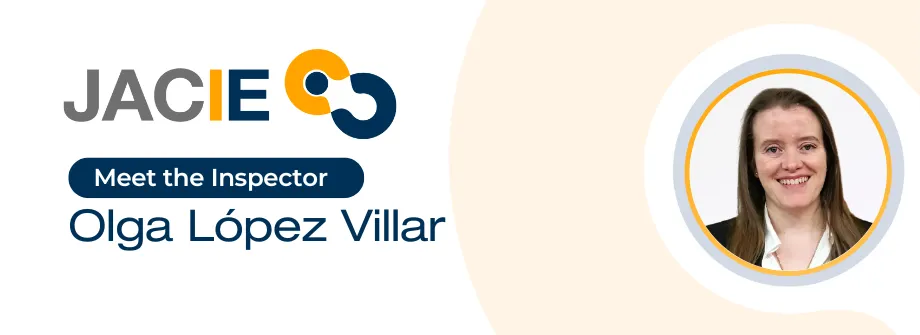
Inspectors are the backbone of JACIE; without them, there is no certification process. Becoming an inspector is a wonderful way to contribute to maintaining global quality standards. As the number of JACIE applications has increased, we are constantly looking for new inspectors to join our ranks. At the moment, we are particularly keen to hear of German, French and Spanish speaking Clinicians and Quality Managers.
Each month, you will have the opportunity to meet with one of our JACIE Inspector who will share his/her experience.
Read our interview with Olga López Villar.
Introduce yourself and your role(s) and position(s) within EBMT and outside of EBMT
I am a haematologist involved in cell therapy, apheresis, processing, and transfusion since the beginning of my career. For more than 12 years, I have also been the Quality Manager (QM) of the transfusion service at the University Hospital of Salamanca, where I work.
I became a JACIE inspector for apheresis and processing in 2012. Some years later, when QM inspectors began to participate in each inspection, I took on that role as well. During these years, I have been part of the Quality Managers Committee, and I am now in my last year as a member of the Inspector Committee. I am proud to say that I have also been part of the Accreditation Committee for several years. I have collaborated in the training of new inspectors and in the last three editions of the standards. As you can see, I have worked with JACIE from many perspectives.
In Spain, I also perform audits for CAT, the Spanish foundation for the quality of transfusion, cell, and tissue therapy.
Why did you decide to become a JACIE inspector?
Another haematologist in my institution was already a JACIE inspector. Our institution was also preparing for JACIE certification, so the process was not entirely new to me. During a meeting of the Spanish Hematology Society, I heard an experienced JACIE inspector speak about the requirements and procedures, and I realised I could do that work. The former director of our transplant programme was sitting next to me, and at the end she encouraged me as well.
What has been the most memorable inspection that you have ever done?
Just one? The inspections outside Spain have all been more challenging—particularly the one in South Africa. An observer from the country helped us understand the legal requirements. Even if the country and regulations are different, the standards are the same, and it is very rewarding to see how a centre manages to comply with them.
Another memorable one was my first inspection as a team leader. The clinical inspector was the same person who had spoken at the meeting where I decided to become a JACIE inspector. I was a little nervous, but she and the whole team were very supportive.
Each inspection has something different to teach, and you always learn.
What ‘keys to successful JACIE certification’ can you share with us?
Certification is a long-term team effort; it does not end once you achieve it. Everyone working in a centre seeking certification must be committed. This is not the responsibility of only the QM and perhaps the director. Each person has responsibilities in operations (clinical, collection, and/or processing) and in quality.
Furthermore, collaboration among the different parts of the programme is essential. Even if services are located in different institutions, it is important to work together for the transplant programme.
How has your career/work benefited from being a JACIE inspector?
I have gained knowledge of the standards, the JACIE process, and different ways to strengthen the QMS. I become more open-minded with each inspection. All of this benefits my professional skills. You also get to know more JACIE inspectors, whom you can contact for different purposes.
Do you have any tips or advice for anyone who aspires to become a JACIE Inspector?
If you have the experience, commitment, and interest—go for it. It takes time to become familiar with the process and, of course, to perform each inspection (pre-inspection, audit, and post-inspection). But you will not be alone; you can learn from other inspectors and from the feedback provided by JACIE Assurance Committee. It is truly rewarding.