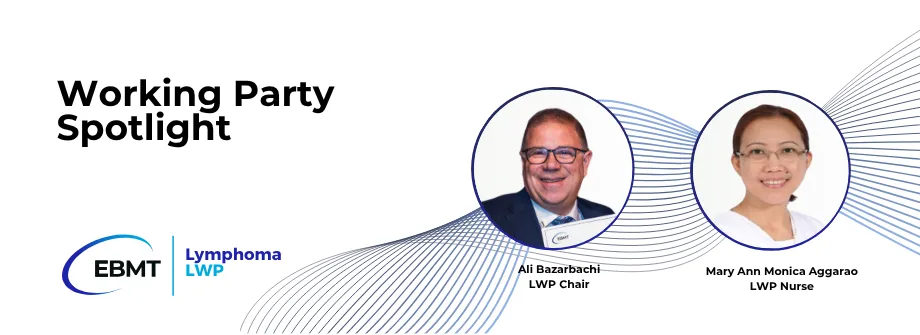
Interview with Ali Bazarbachi (Chair) and Mary Ann Monica Aggarao (Nurse Representative)
Introduce yourself and your role(s) and position(s) within EBMT and outside of EBMT
Ali Bazarbachi: I am a haematologist, currently Professor of Medicine and founding director of the JACIE-certified bone marrow transplantation programme at the American University of Beirut. I trained as an MD and PhD in Paris and have extensive experience in translational and clinical research focusing on targeted therapies for haematological malignancies in general and lymphomas in particular. I also have internationally recognised expertise in adult T cell leukaemia/lymphoma, a rare aggressive disease. After more than a decade of involvement in various functions within EBMT, I have served as Chairman of the Lymphoma Working Party since 2024. I am also an active EBMT Board Member as Scientific Council representative with the education portfolio. Finally, I contribute to the Practice Harmonisation and Guidelines Committee as educational representative.
Mary Ann Monica Aggarao: I am the Bone Marrow Transplant (BMT) Nurse Educator at Yas Clinic Hospital – Bone Marrow Transplant Centre in Abu Dhabi City. Our BMT programme, established nearly four years ago, has rapidly grown into a leading institution recognised as a Centre of Excellence by the Department of Health Abu Dhabi, JACIE certified in 2024 and FACT certified in the last quarter of 2025.
I have been a member of the EBMT since 2024, actively supporting the advancement of transplant nursing education and research. All BMT nurses completed online EBMT certificates for continuing education. Our team submitted our first nursing abstract, titled “Effect of Cellular Therapy on Patients’ Quality of Life: A Cohort Study at Abu Dhabi Stem Cell Centre, UAE Centre of Excellence for HSCT.” This abstract was accepted and presented as a poster at the 51st Annual Meeting of the EBMT, delivered by our Director of Nursing. In recognition of my contributions, I also served as an abstract reviewer for the EBMT 2026 Annual Meeting in Madrid.
Beyond my involvement with the EBMT and our strong team of nursing leads, I actively support national and regional oncology nursing advancement as the first APHON (Association of Paediatric Haematology/Oncology Nurses) Instructor in the UAE, contributing to the development of safe, standardised paediatric haematology and oncology care. Our centre proudly maintains both APHON and ONS-certified providers, ensuring high-quality, evidence-based practice across the continuum of care. As the primary BMT Nurse Educator at Yas Clinic Hospital – Bone Marrow Transplant Centre, I remain dedicated to strengthening transplant nursing practice, enhancing staff competency and supporting the continuous growth and excellence of our expanding BMT programme.
What are the main activities - in terms of research and education - that your Working Party (WP) has been leading? And is there a memorable project that you would like to highlight?
Ali Bazarbachi: Since 2024, we have introduced a new working modality. We have seven subcommittees within the Lymphoma Working Party (WP), each led by recognised experts in the field with demonstrated experience in EBMT. Each committee meets with the WP board and staff on a regular basis. This new organisation has brought more dynamism and efficiency and significantly increased the productivity of the WP, which has translated into numerous oral and poster presentations at major meetings. The publication record of the WP has also qualitatively and quantitatively improved, with numerous manuscripts published in journals with very high impact factor. The LWP also participates actively in EBMT’s effort to harmonise practices and guidelines and has coordinated European expert consensus on transplantation and cellular therapy for peripheral T cell, cutaneous T cell, Hodgkin and mantle cell lymphomas. The yearly educational meetings in the autumn are always memorable events, connecting experienced experts with the younger generation in a smaller-scale format in beautiful European cities.
Mary Ann Monica Aggarao: Being recently new in the WP, I am still exploring what to expect as a member of the Lymphoma Working Party. However, as a new member of the Working Party, I am committed to gaining a deeper understanding of its research priorities, educational goals and collaborative framework. Being part of the LWP allows me to explore how international best practices, evidence-based guidelines and multidisciplinary expertise come together to improve outcomes in haematopoietic stem cell transplantation and cellular therapy. This early stage of learning is an opportunity for me to engage meaningfully with the group’s direction and understand how I can contribute most effectively.
Are you facing any challenges or trends within your field that are affecting any current/on-going projects within your Working Party?
Ali Bazarbachi: The challenges include integration and coordination with activities of other Working Parties and dealing with increased activity with limited resources. We are fortunate to work with dedicated data managers, coordinators and statisticians in the EBMT Paris Office, on whom we can rely to achieve our goals. These are fascinating times for lymphoma physicians, with rapid development of new immune- and cellular-based therapies.
Mary Ann Monica Aggarao: As a new member of the Working Party, I have observed that rapid advancements in cellular therapies—especially CAR-T—and the increasing complexity of patient profiles are key challenges influencing current projects. These trends require continuous updates in nursing education, competency development and standardised clinical guidance. Additionally, the growing focus on patient-reported outcomes and long-term survivorship highlights the need for more consistent data collection and aligned tools across centres. Strengthening cross-centre training and communication will further support the WP’s ability to address these evolving demands effectively.
What are your goals in the near future?
Ali Bazarbachi: We want to consolidate the achievements of the last two years and build on our structure to push all the ongoing projects to high-impact publications directly useful to haematologists within EBMT and worldwide.
Mary Ann Monica Aggarao: As I continue integrating into the Working Party, my goal is to apply this learning to elevate our educational initiatives, contribute to ongoing research activities and support projects that align with EBMT’s mission. I am motivated to grow both personally and professionally through this experience, and I look forward to contributing more significantly to the LWP by bringing forward the nursing perspective, supporting evidence-based practice and helping strengthen transplant care within our institution and across the wider EBMT community.
Can you tell us what membership of your Working Party looks like? What do members of your Working Party get to do?
Ali Bazarbachi: Participation in the Lymphoma Working Party is open to any healthcare professional with an interest in lymphoma who wishes to engage in its activities and attend its meetings.
Members of the LWP can contribute to scientific discussions, develop and support research projects, join educational initiatives, and collaborate with colleagues across the EBMT network to advance the field of lymphoma transplantation and cellular therapy.
Attendance at LWP meetings provides an opportunity to actively discuss ongoing projects and submit new study proposals, if you are a researcher affiliated with a Full Centre Member of the EBMT. All proposals are presented and discussed, reflecting our commitment to broad inclusivity and collaborative development. Our projects foster collaboration between junior and senior investigators, helping to support and empower the next generation of researchers and clinicians.
Mary Ann Monica Aggarao: In my role as a BMT Nurse, I am deeply invested in strengthening transplant nursing standards, competency development and the overall quality of patient care. My responsibilities include designing and delivering structured BMT education programmes, supporting clinical staff in mastering complex transplant procedures and ensuring that our nursing practice aligns with global frameworks such as JACIE, FACT and DOH Centre of Excellence standards. Being part of the WP reinforces this work, giving me access to shared knowledge, research insights and educational tools that directly enhance the development of our BMT team.
What would you like to say to encourage young investigators / trainees to join your Working Party?
Ali Bazarbachi: As mentioned in the previous question, our WP is inclusive and accessible to young colleagues. Our secretary has recently co-founded the EBMT Trainee Committee and used to be a trainee member of the WP. This emphasises the continuous effort of our WP to include junior members in all our activities. We encourage young colleagues to attend our educational Working Party through case report submissions and applications for travel support.
Mary Ann Monica Aggarao: Being involved in the LWP, with the support of our organisation’s Haematology Multidisciplinary Team and Nursing Leadership under the guidance of our Director of Nursing (Ms Dina El Mouzain), continues to expand my perspective on the evolving landscape of lymphoma care and cellular therapies. Collaboration with experts within the WP, including Dr Mohammed Abuhaleeqa (Haematology Consultant), highlights the value of mentorship and interdisciplinary teamwork in advancing professional development.
These opportunities strengthen understanding of specialised areas such as CAR T cell therapy, lymphoma management and post-cellular therapy nursing care, while reinforcing a commitment to continuous learning. I remain focused on enhancing transplant nursing practice, building clinical competency and contributing to the sustained growth and excellence of our organisation’s BMT programme, while encouraging early career colleagues to actively engage in learning and collaborative practice.