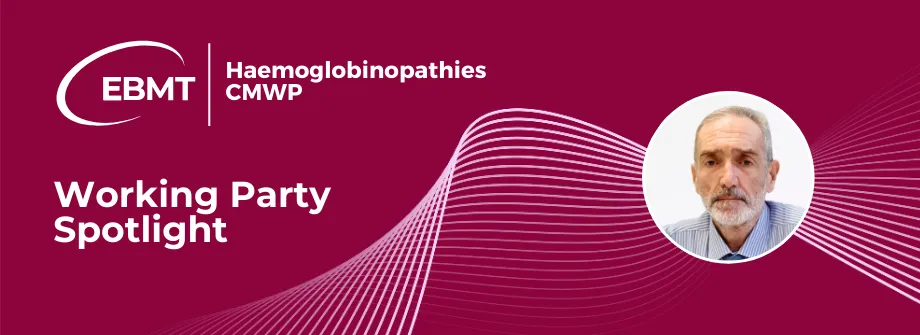
Interview with Emanuele Angelucci (Chair)
Introduce yourself and your role(s) and position(s) within EBMT and outside of EBMT
My name is Emanuele Angelucci. I am a haematologist and I have been working in transplantation for haemoglobinopathies for many years. I was involved in the early experience in Pesaro with Professor Lucarelli and took part in the first studies on transplantation for thalassaemia, published in The New England Journal of Medicine and The Lancet. I am chair of the EBMT Haemoglobinopathies Working Party. I am currently based in Genoa, where I lead the Haematology and Cellular Therapy Unit.
What are the main activities - in terms of research and education - that your Working Party has been leading? And is there a memorable project that you would like to highlight?
Our research focuses on defining the role of haematopoietic cell transplantation and gene therapy in haemoglobinopathies. We aim to refine conditioning regimens, identify the main criteria for therapeutic indications and clearly define clinical outcomes.
From an educational standpoint, we have already organised two dedicated events for the Working Party—one in Genoa in 2024 and one in Regensburg in 2025. Looking ahead, we are preparing the 2026 meeting in Regensburg as well as a special educational session focused on low-income countries.
Our main goal is to bring together what we know from the transplantation world and from conventional treatments for haemoglobinopathies so that our patients can get the best possible care at the right time.
Our most important—and I would say fundamental—project is the ongoing data collection. The aim is to ensure that, for the over 10,000 patients already registered, we maintain high-quality data to obtain accurate insights and produce high-quality reports with fully reliable results.
Are you facing any challenges or trends within your field that are affecting any current/on-going projects within your Working Party?
As I mentioned, our biggest challenge is to complete our Registry and generate high-quality data, and for that we need the collaboration of all the researchers and physicians involved.
What are your main goals in the near future?
By collecting high-quality data, we can better compare different treatment options and make them more feasible, always with our patients’ best interests in mind. The goal is simple: the right therapy for the right patient at the right time. We are paying particular attention to low-income countries, where the vast majority of our patients live, to help ensure they also have access to these curative therapies.
Can you tell us what membership of your Working Party looks like? What do members of your Working Party get to do?
Our Working Party includes all colleagues involved in transplantation and gene therapy for haemoglobinopathies. We also work closely with specialists in the pathophysiology of haemoglobinopathies and in conventional treatments because sharing knowledge is essential for making progress.
What would you like to say to encourage young investigators / trainees to join your Working Party?
Today, with the advances in transplantation using different types of donors and the arrival of gene therapy, we can offer a chance of cure to many patients living with these chronic conditions. Just as importantly, we now have the opportunity to expand access to these curative therapies in low-income countries, where most patients live and have so far faced major challenges in accessing these technically complex treatments.