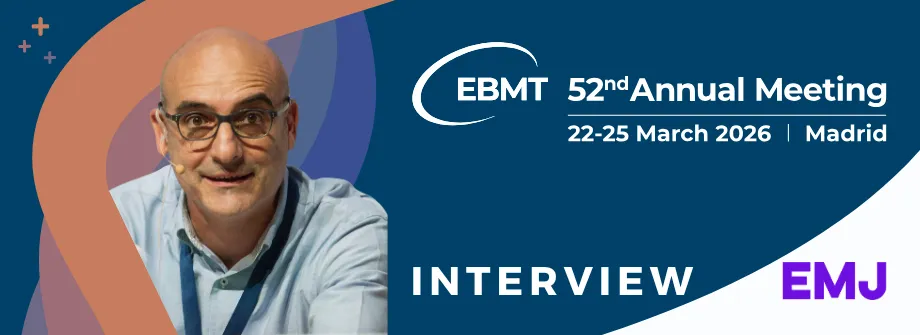
Joaquín Martínez-López, Head of Department, Hematología, Hospital Universitario 12 de Octubre, Madrid; Professor of Medicine, Complutense University of Madrid, Spain.
This interview was developed in collaboration with European Medical Journal (EMJ), with editorial support and medical writing provided by EMJ.
- As Co-Chair of the Scientific Committee, what vision guided the development of the EBMT 2026 scientific programme?
This field is very interesting because there are a lot of ambassadors for cell therapies. Cell therapy is going to be a key treatment for haematological malignancies, especially lymphoid malignancies. In some indications, such as multiple myeloma and lymphoma, it is now emerging as a competitor to transplantation. This is going to be a focus of the Congress. Other relevant aspects in the field of transplantation are the advancement in support therapy and the improvement of the efficiency of these procedures.
- What do you see as the most transformative themes shaping transplantation and cellular therapy this year?
In my opinion, the most transformative theme would be the implementation of these therapies in newly diagnosed patients. Though we have limited data, there are very interesting ongoing clinical trials whose first results in some diseases are encouraging. Regarding transplantation, for example, donor selection and the implementation of unrelated donor transplantation are among the most relevant aspects currently being addressed at the Congress.
- How does EBMT 2026 reflect the recent advances in the field of transplantation and cellular therapy?
I think this Congress is becoming more relevant in the field of transplantation and cellular therapy. In Eastern and Central Europe, and in other regions, such as South America, the Middle East, and even countries like Japan, China, and India, many physicians find it very interesting. The presentations at this Congress are highly innovative and cover new advances in the field. That is why many specialists from different parts of the world want to attend.
- What new formats or innovations in the programme are you most excited about?
There are some sessions, for example, where we bring together people from the field of cell therapy and people from the field of stem cell transplantation. They will debate the advantages and disadvantages of these therapies in certain indications where they are competing.
- How does this year’s scientific agenda translate into tangible improvements for patients undergoing transplantation and cellular therapy?
I think that some topics, such as improvement of transplantation, for example, to decrease infection, and other complications like graft versus host disease, are going to be very relevant to the agenda.
- What message would you like early-career professionals to take away from EBMT 2026?
I think it’s going to be a space for collaboration in the field of transplantation and cellular therapy, and for improving these treatments to provide better care for our patients.
- Looking ahead, how do you see EBMT shaping global standards in transplantation and cellular therapy over the next decade?
I think the impact of this Congress is global. It is, probably, the first-in-class Congress with a focus just on transplantation and cell therapy in the world.
Looking to the future, I believe cell therapy will become easier to deliver. These treatments will likely become less complex and move into the first line of therapy. In some diseases, such as myeloma or lymphoma, which are still very difficult to cure, cell therapy could become the foundation of curative treatment.
As for transplantation, I think it will become less toxic, with lower mortality. It will probably be applied more frequently in elderly patients and in diseases such as acute leukaemia, where it remains a key therapeutic option.
- In the context of EBMT and this year’s theme, Advancing the Art of Patient Care, how do you believe innovations in transplantation and cellular therapy can be better aligned with patient-centred outcomes and quality of life?
Of course, this is critical, especially for cell therapy, because these therapies will likely have a great impact on the quality of life, especially for younger patients. Many of them may be able to return to a normal life within a few months, with a very good quality of life. This is very important because, in the last decade, the treatments for some diseases were very prolonged, with a lot of specificity. I think this is going to be another step towards improving quality of life.