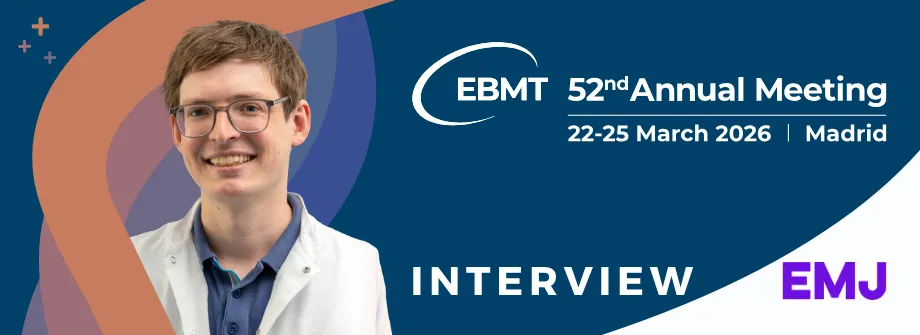
Julius Fischer, Department of Radiation Oncology, Technical University of Munich (TUM), TUM School of Medicine and Health, TUM University Hospital, Munich, Germany.
This interview was developed in collaboration with European Medical Journal (EMJ), with editorial support and medical writing provided by EMJ.
- Congratulations on receiving the Jon J. Van Rood Award at the 2026 EBMT Annual Meeting. What does this recognition mean to you personally and professionally?
Receiving the Jon J. Van Rood Award is a great honour. van Rood was a true pioneer; someone who not only advanced the field of transplantation research but also helped define how we think about immune recognition in human disease.
For me, this recognition represents more than a milestone within the field of immune cell-mediated tissue injury. It highlights how ideas originating from transplantation research continue to shape broader areas of cancer therapy. As my work bridges genotoxic tissue injury, for example, during transplantation conditioning, with immunobiology and radiation oncology, I see this award as an encouragement to carry forward that pioneering spirit by using fundamental immunology to address complex clinical challenges across disciplines.
- Can you briefly describe the research project or body of work that led to this achievement?
Our work is rooted in a simple but fundamental question: how does the immune system respond to tissue damage caused by genotoxic stress and subsequent waves of overwhelming immune activation?
Using allogeneic transplantation as a model, we revisited the role of interferon gamma (IFN-γ), traditionally viewed as a driver of tissue injury, and found that, in the right context, it can instead promote regeneration. Importantly, we were able to translate these findings to other settings of isolated intestinal injury, such as after radiation therapy, and identify a broader principle: in combination with IL-10 signalling, for example, mediated by regulatory T cells, IFN-γ supports intestinal epithelial repair.
This shifts the perspective from viewing immune responses purely as destructive forces to recognising them as context-dependent regulators of tissue integrity. It is this balance between damage and repair that increasingly shapes how we understand immune function in both transplantation and cancer.
- How does your work build on the legacy of van Rood and contribute to advancing histocompatibility, immunogenetics, or donor selection in transplantation?
van Rood’s work established the importance of immune recognition in determining transplantation outcomes. Building on this, our work focuses more on how immune responses function within tissues.
By identifying mechanisms through which immune cells can either drive injury or promote regeneration, we aim to contribute to a more nuanced understanding of immune compatibility, one that includes not only recognition but also the quality of the response. These concepts are increasingly relevant not only for transplantation, but also for other settings involving immune-mediated tissue damage, such as immune-related adverse events following cellular therapies or immune-activating targeted treatments, including immune checkpoint inhibitors.
- What do you see as the most significant clinical implications of your findings for patients undergoing haematopoietic cell transplantation?
One key implication is that inflammatory pathways are not purely detrimental but can have regenerative roles depending on the context. This suggests that future therapies may need to move beyond broad immunosuppression toward more selective modulation of immune responses. In transplantation, this understanding could help protect the intestinal barrier and improve outcomes in graft-versus-host disease.
At the same time, we found that similar principles may apply to other areas of cancer therapy, where preserving tissue integrity while maintaining effective immune responses remains a major challenge.
- Were there any pivotal moments or discoveries during your research that particularly shaped the direction of your work?
A pivotal moment was realising that IFN-γ is not only a driver of tissue damage, but can also promote regeneration under specific conditions. This challenged a central assumption in the field and shifted our focus toward how inflammatory signals can be harnessed for tissue repair. Another key insight was that regulatory T cells actively orchestrate intestinal regeneration independently of their classical immunosuppressive functions.
Equally important was recognising that these principles extend beyond alloimmunity, particularly to radiation-induced tissue injury. This opened a new direction for our work.
- Collaboration is central to progress in our field. How have partnerships within EBMT or with international colleagues influenced your research?
Collaboration has been essential, particularly in connecting different areas of expertise. This network has been invaluable in linking experimental work with clinical questions and in shaping a more integrated view of immune-mediated tissue injury and repair.
Work within transplantation research provided a strong mechanistic foundation, while collaborations with colleagues in oncology and radiation biology helped place these findings into a broader clinical context.
CTIWP Cellular Therapy & Immunobiology Working Party Session
Tuesday, March 24, 09:00 – 10:20
GOYA
CTIWP-2 Tissue-adapted Tregs harness inflammatory signals to promote intestinal repair from therapy-related injury
09:05 – 09:25
Oral Presenter: Julius Fischer (Germany)