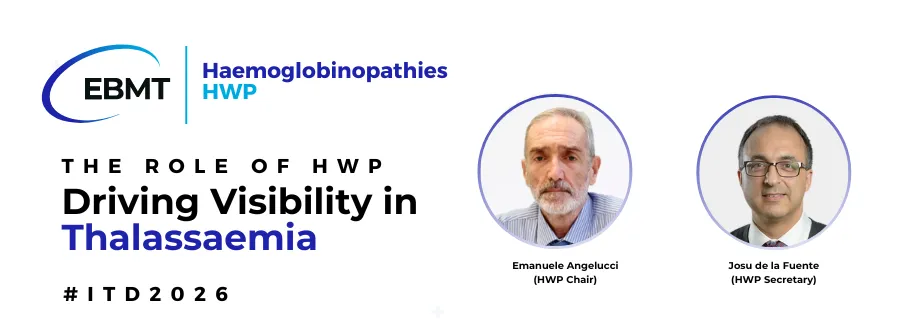
By Emanuele Angelucci (HWP Chair) and Josu de la Fuente (HWP Secretary)
On 8 May 2026, the global community marks International Thalassaemia Day under the theme: “Hidden No More – Finding the Undiagnosed. Supporting the Unseen.”
This year’s campaign is a call to action—urging earlier diagnosis, equitable access to care, and greater recognition of every individual living with thalassaemia. It also challenges the medical and scientific community to address a fundamental issue: many patients remain underdiagnosed or insufficiently captured within healthcare systems, whether due to delayed diagnosis, limited access to specialised care, or insufficient long-term follow-up.
At EBMT, and within its Haemoglobinopathies Working Party, ensuring patients are properly identified and represented is not just an aspiration—it is an ongoing commitment driven by data, collaboration, and innovation.
Improving patient identification through data
One of the most powerful tools in addressing underdiagnosis and inequity in care is systematic, high-quality data collection. Without reliable data, patients remain overlooked—not only from health systems but also from the research and policy decisions that shape their care.
The EBMT Registry plays a crucial role in changing this reality. By capturing detailed clinical information across countries and centres, it helps identify patient populations that might otherwise remain overlooked. This is particularly important in regions where thalassaemia prevalence is high but structured data collection has historically been limited.
Through ongoing efforts to strengthen and expand data collection, the Haemoglobinopathies Working Party is contributing to a clearer, more accurate picture of thalassaemia and related disorders across Europe and beyond. Each data point represents a patient whose experience can now inform better care, improved guidelines, and more inclusive research.
The strength of a large, high-quality registry
Today, the EBMT Registry includes data on more than 10,000 patients with haemoglobinopathies, including transfusion-dependent thalassaemia and sickle cell disease. This scale is not only impressive—it is transformative.
A large, high-quality dataset allows for:
- Robust clinical insights, grounded in real-world evidence
- Meaningful analysis of outcomes across different treatments and populations
- Continuous improvement of clinical practices, based on observed results
In particular, the depth of data on transplant outcomes and emerging therapies offers a unique opportunity to better understand how treatments perform outside controlled clinical trials.
Importantly, EBMT’s membership spans regions with some of the highest global prevalence of haemoglobinopathies, placing the organisation in a unique position to generate reliable and globally relevant evidence. This geographic diversity ensures that findings are not only scientifically robust but also reflective of real-world patient populations.
Collaboration at the heart of progress
Improved recognition is not achieved through data alone—it requires strong collaboration across disciplines, institutions, and patient communities.
EBMT works closely with partners such as the Thalassaemia International Federation, a leading global patient organisation advocating for individuals with thalassaemia. This collaboration is further strengthened by the presence of TIF representatives within the HWP Board, ensuring that the patient voice remains central to scientific and clinical efforts.
Such partnerships are essential to:
- Align clinical research with patient needs
- Promote awareness and education
- Advocate for equitable access to diagnosis and treatment worldwide
By bridging the gap between clinicians, researchers, and patient advocates, these collaborations help ensure that all patients are recognised and their needs addressed.
A new era: gene therapy and the role of real-world evidence
The landscape of thalassaemia treatment is rapidly evolving. Notably, thalassaemia has been at the forefront of the first clinical applications of gene therapy, marking a major milestone in the field of haemoglobinopathies.
While these innovative therapies represent important advances, they also raise important questions:
- Which patients benefit most?
- What are the long-term outcomes?
- How should care pathways adapt to these new treatments?
This is where real-world registries such as EBMT become indispensable. By systematically collecting and analysing post-treatment data, the registry enables:
- Identification of patient populations most likely to benefit
- Optimisation of treatment strategies
- Deeper understanding of long-term safety and care needs
In this new therapeutic era, registries are not just supportive tools—they are essential infrastructure for responsible innovation and patient-centred care.
From visibility to value
The theme “Hidden No More” is ultimately about more than recognition—it is about value. Ensuring patients are recognised means acknowledging their needs, understanding their journeys, and ensuring they benefit from advances in science and medicine.
Through its registry, collaborative networks, and commitment to innovation, EBMT is helping to translate improved recognition into tangible outcomes:
- Earlier and more accurate diagnoses
- Improved treatment strategies
- Better long-term care for patients worldwide
Looking ahead
On this International Thalassaemia Day, EBMT reaffirms its commitment to working alongside clinicians, researchers, and patient organisations to ensure that no patient is left unrecognised or undiagnosed.
By strengthening data collection, fostering collaboration, and supporting the responsible implementation of novel therapies, we move closer to a future where every person living with thalassaemia is fully recognised, appropriately managed, and supported throughout their care journey.
Watch the interview with Nada Hamad and Sunil Bhat who discuss the biggest barriers to HCT and cellular therapy access, from donor shortages to systemic challenges, and how solutions like haploidentical transplants, graft engineering, and international collaboration can help close the gap.