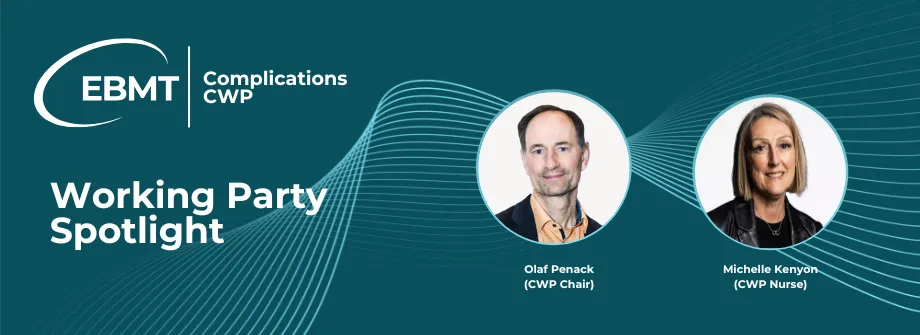
Interview with Olaf Penack (Chair) and Michelle Kenyon (Nurse Representative)
Introduce yourself and your role(s) and position(s) within EBMT and outside of EBMT
Olaf Penack: My motivation to work for EBMT as CWP chairperson derives directly from my daily experience as a physician. I am Director of the Advanced Cellular Therapy Programme in the Department of Haematology, Oncology and Tumour Immunology at Charité Universitätsmedizin Berlin, Campus Virchow Clinic. My aim is to improve outcomes of cellular therapies through optimised clinical management as well as the development of novel therapeutic approaches. One specific focus of my work is to study the function of the endothelium during cellular therapies in pre-clinical models as well as in clinical studies. This knowledge can facilitate the development of endothelium-based therapeutic approaches in the fields of stem cell transplantation and cellular therapies.
Michelle Kenyon: I am a Consultant Nurse specialising in stem cell transplantation, with a particular focus on survivorship, rehabilitation and treatment complications. I work at King’s College Hospital NHS Foundation Trust in London, where my role encompasses advanced clinical practice, service and workforce development, education and research across transplant and cellular therapy pathways.
You may know me as a former President of the EBMT Nurses Group and I am delighted to now have a role as the nurse representative in the Complications Working Party, where I hope to contribute some of my experience to education, research and the advancement of nurse-led practice across transplant and cell therapy pathways.
What are the main activities - in terms of research and education - that your Working Party (WP) has been leading? And is there a memorable project that you would like to highlight?
Olaf Penack: The main activities are:
- Planning, conducting, analysing and publishing studies on complications following stem cell transplantation and cellular therapies.
- Collaborating with other EBMT Working Parties and with the EBMT Nurses Group.
- Intensifying work with patient representatives to ensure patient-centred scientific action.
- Giving evidence-based recommendations for the clinical management of patients with complications following CAR-T cell therapy and stem cell transplantation.
- Organising educational meetings: Educational Course on Infections and Complications after Stem Cell Transplantation and CAR T-cell Therapy – Madrid, Spain – 19-21 November 2026. In collaboration with the EBMT Infectious Diseases Working Party.
Michelle Kenyon: As the newest recruit, I am still on a very steep learning curve. Simply, our Working Party focuses on research, guideline development and education around transplant and cellular therapy complications. The range of activities seems extensive with a number of cross-cutting streams of work as well. As a result, the group works inclusively and is very collaborative. A key highlight so far has been the multiprofessional approach to the Working Party’s activities. Every voice has space to be heard and contribute, including of course patient representatives.
Are you facing any challenges or trends within your field that are affecting any current/on-going projects within your Working Party?
Olaf Penack: Despite all our efforts and progress in the field, significant clinical problems persist that we need to address. The long-term survival rates of patients after SCT or cellular therapies remain unacceptably low. The main reasons are high relapse rates and treatment-related mortality. A key difficulty is that we do not use the full therapeutic potential of allogeneic SCT because our standard prophylactic and therapeutic approaches mainly use immunosuppressive drugs, leading to unwanted inhibition of the anti-malignant immune effects. To improve this dismal outcome, we need to optimise current management and develop novel therapeutic strategies.
Michelle Kenyon: The increasing number of long-term survivors is both an opportunity and a challenge. Combined with the rapid expansion of cellular therapies, including CAR-T, this has significantly increased the complexity of post-treatment care. Workforce pressures and variation in survivorship services across centres reinforce the need for strong nursing and medical leadership and multidisciplinary collaboration within and beyond EBMT.
What are your goals in the near future?
Olaf Penack: Central aims of CWP are:
- To improve the scientific and educational output and quality by expanding collaboration with other EBMT Working Parties.
- To strengthen partnerships with international societies as well as with potential investors in the field.
- To intensify work with patient organisations and to implement the documentation of patient-reported outcomes within EBMT.
- To promote retrospective and prospective studies on complications after SCT and cellular therapies under the EBMT umbrella.
Michelle Kenyon: In the near future, my goal is to actively contribute to the EBMT Complications Working Party by bringing a nursing perspective to work focused on acute and long-term complications following transplant and cellular therapy. The group’s collaborative approach aligns closely with my values and I see clear opportunities to support existing projects and contribute to new initiatives.
Can you tell us what membership of your Working Party looks like? What do members of your Working Party get to do?
Olaf Penack: It is very easy to become a CWP member. Just email us: cwp@ebmt.org. We will put you on the mailing list and this way you are informed about our activities. If you would like to be involved in studies or education, please reach out to us. We are interested in any project on complications that brings meaningful benefit to stakeholders in our field – most importantly to our patients.
Michelle Kenyon: EBMT Working Party membership is international and multidisciplinary, bringing together nurses, physicians and researchers as well as patients and specialists beyond HCT. Membership provides an amazing opportunity to contribute expertise, collaborate across centres and help shape EBMT work that informs clinical practice and can truly benefit patient care.
What would you like to say to encourage young investigators / trainees to join your Working Party?
Olaf Penack: Welcome, our doors are always wide open!
Michelle Kenyon: I would strongly encourage early-career nurses and trainees to get involved. Transplant and cellular therapy nursing is evolving rapidly and the Complications Working Party offers a supportive environment to learn, collaborate internationally and contribute to work that genuinely improves patient outcomes.