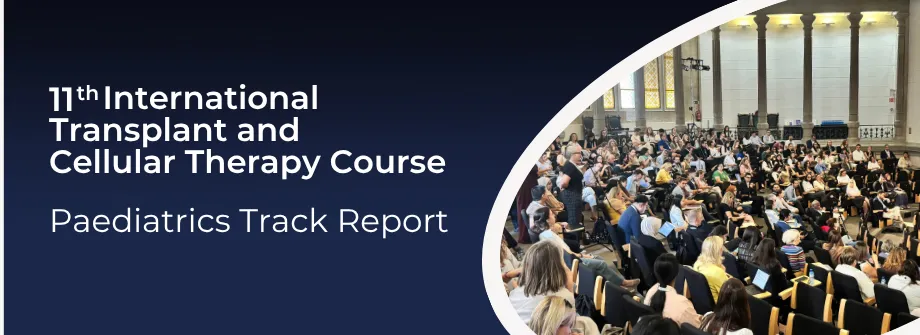
The 11th EBMT International Transplant and Cellular Therapy Course (ITCTC) took place in Barcelona, Spain, from 11–13 September 2026, bringing together experts in the field and junior trainees for three days of learning focused on advances in haematopoietic cell transplantation (HCT) and innovative cellular therapies. The second day featured a dedicated paediatric track, highlighting the management and care of children with haematological, immunological, and metabolic disorders.
Session I
The first session was chaired by Krzysztof Kalwak (PL), Chair of the EBMT PDWP, and Claire Horgan (UK), the deputy chair of the PDWP Young Investigators Subcommittee. Krzysztof Kalwak opened the session with a presentation on the role of second HCT or chimeric antigen receptor T-cell (CAR-T) therapy following post-transplant ALL relapse. He highlighted that consolidative HCT should be considered in patients eligible for transplantation who have not undergone a prior HCT, particularly following CD28-based CAR-T therapy, loss of B-cell aplasia within 6 months, or detection of MRD at any level following CAR-T infusion.
Claire Horgan provided an informative overview of the current landscape surrounding the use of T-replete cord blood transplantation (UCBT), with particular emphasis on its application in pediatric acute myeloid leukemia (AML). In particular, the low incidence of chronic graft-versus-host disease (GVHD), its value for patients without a suitable donor, and favourable outcomes in MRD-positive patients were highlighted. Novel approaches, including dilanubicel infusion in the course of UCBT, as well as cord blood expansion strategies to improve engraftment, were also explored.
The session continued with an excellent state-of-the-art overview of the use of CAR-T therapy in T-cell acute lymphoblastic leukemia (T-ALL) by Robert Chiesa (UK). He discussed the promising results from Great Ormond Street Hospital with universal BE-CAR7 T cells, which induced remission in patients with relapsed/refractory T-ALL and enabled subsequent bridging to HSCT in most patients, before concluding with a comprehensive review of the literature in this context.
The session continued with an engaging case presentation by Alexandra-Flavia Tule (RO), who explained how the sequential use of tisagenlecleucel and haploidentical HSCT in a child with relapsed B-ALL following a previous HSCT resulted in durable remission.
Finally, Claire Horgan closed the session by presenting the Paediatric Masterclass Project on behalf of the EBMT Paediatric Educational Committee. The initiative aims to strengthen paediatric HCT and cellular therapy education, harmonise clinical decision-making across centres, and build a network of future paediatric HCT experts. Further information regarding the application process for this competitive selection will be published in early 2027, with an in-person component planned during the 2027 PDWP meeting in Krakow.
Session II
Session II, focusing on inborn errors of immunity (IEI), was chaired by Robert Chiesa (UK) and Lisa Ott de Bruin (NL). The first presentation was delivered by Robert Chiesa, who presented data from a large cohort of patients with osteopetrosis, recently published by the EBMT IEWP. The study highlighted that, although HCT is the only curative option for osteopetrosis, it remains associated with significant transplant-related mortality (TRM) and a risk of graft failure. Nevertheless, overall survival has improved substantially over the past 30 years. In addition, novel therapeutic approaches, including gene therapy, are expanding treatment options for these patients.
The following presentation was delivered by Reem Elfeky (UK), who provided an overview of HCT in Chediak–Higashi disease. HCT currently represents the only curative treatment option for this condition; however, it remains associated with significant rates of graft failure and GVHD. Important unmet clinical needs also persist, particularly the progression of neurological complications despite successful transplantation. Future priorities include improving neurological manifestations, optimising transplant strategies, and establishing comprehensive multidisciplinary long-term follow-up.
The session continued with an insightful talk entitled “Immunology in hematology and hematology in immunology: a joint venture or a separate field?” by Benedetta E. Di Majo (UK). The presentation highlighted the increasingly blurred boundaries between immunology and hematology, illustrating this overlap through two brief case studies. It provided an overview of the close interplay between the two fields, particularly in the context of HCT, where their intersection is particularly evident. The presentation further emphasised the importance of a multidisciplinary approach to patient management.
Michail Matalliotakis (UK) presented an interesting case of EBV-associated lymphoproliferative disease in CTPS1 deficiency, treated with HSCT and adoptive cellular therapies.
Oral Session
The paediatric track continued in the afternoon, chaired by Hilda Mekelenkamp (NL) and Benedetta E. Di Majo, with a challenging clinical cases session that brought together trainees from all over the world.
Agnieszka Sobkowiak (PL) presented a case of donor-derived virus-specific T cells for the treatment of refractory adenovirus reactivation after allogeneic HSCT. Ankita Chakraborty (IN) presented a child with relapsed/refractory ALK-positive anaplastic large-cell lymphoma who achieved durable remission with crizotinib following post-HSCT relapse. Amanda Campbell (US) discussed the challenges of bridging a child affected by hypomorphic RAG deficiency with immune dysregulation to HSCT. “Ruxolitinib-mediated bridging to HSCT and therapy of intestinal GVHD in neonatal Artemis-SCID” was presented and discussed by Judit Nyiro (DE). Kalasekhar Vijaya (UK) presented three interesting cases of X-linked adrenoleukodystrophy (X-ALD) managed with allogeneic HSCT. Zorana Janković Jovanović (RS) presented a rare case of invasive pulmonary mucormycosis during treatment of post-HSCT AML relapse. Finally, Shivani Patel (IN) closed the session with a case of haploidentical HSCT in IL2RG-deficient SCID complicated by ARDS and complex immune recovery.
Session III
The final session was chaired by Carlo Dufour (IT) and Selim Corbacioglu (DE). Carlo Dufour described the current landscape of telomeropathies, which encompass a broad spectrum of clinical phenotypes and severity. Different therapeutic approaches were discussed, ranging from conservative treatments such as androgens and thymidine to HCT, for which outcomes remain poor. Data were also highlighted showing no difference in survival with the addition of 200 cGy TBI to Flu/Cy conditioning, as well as emerging approaches such as gene therapy.
Luca Vinci (DE) followed with a comprehensive overview of pediatric myelodysplastic syndromes (MDS), addressing refractory cytopenia of childhood (RCC), GATA2 and SAMD9/SAMD9L deficiencies, and therapy-related myeloid neoplasms. Key topics included histopathological classification and treatment strategies in RCC, as well as HSCT outcomes and conditioning approaches. Unpublished data from Freiburg on therapy-related myeloid neoplasms showed overall poor HSCT outcomes, with younger age associated with better survival.
The following talk, by Selim Corbacioglu, provided an overview of HSCT and cellular therapy approaches for haemoglobinopathies, focusing on the indications for curative treatment in sickle cell disease (SCD) and transfusion-dependent thalassemia (TDT). Key considerations included careful patient counselling, modern conditioning regimens, alternative donor options, and established and emerging gene therapy approaches.
A final case presentation by Annie Costa (BR) concluded the Paediatric Track, featuring two rare cases of unstable haemoglobinopathies treated with HSCT, both achieving sustained donor chimerism and long-term transfusion independence.
Overall, the Paediatric Track brought together experts and trainees from around the world to discuss topics spanning haematological and oncological diseases, immunological disorders, and challenging HSCT clinical cases, fostering a valuable exchange of knowledge and experience across different centers.